The question has been asked many times; why is it that fantasy is so familiar? Or, to phrase it another way, why are dwarves thought of as mountain dwelling smiths and elves nature loving forest folk? I posit that the reason we resonate with these familiarities in genre fantasy is because they are simple retellings of core mythology from hundreds, or in some cases thousands, of years ago.
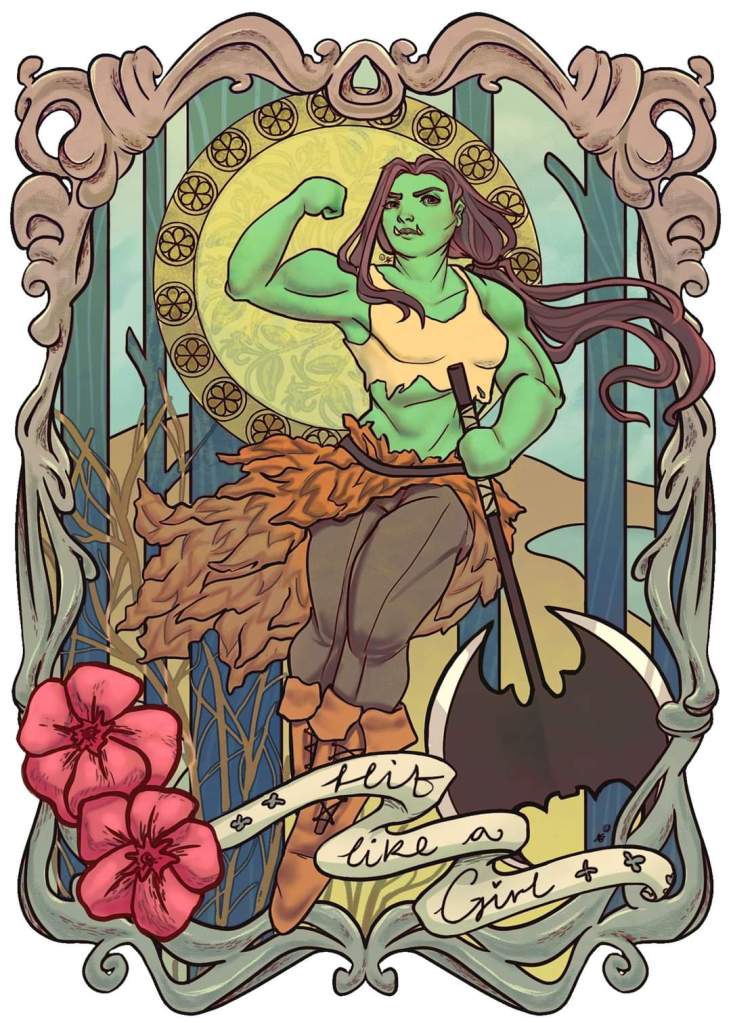
Sable, one of my wife’s characters, art by the ever lovely Shan
This may seem an obvious thing to state. It should not be hard for anyone to say that Tolkien, the father of the genre, drew heavily from myths and legends. Yet the question is a tad more specific. Why do we as modern people view fantasy as a genre? It could be argued that Willy Wonka’s Chocolate Factory is Fantasy, yet we would not find it listed with Elric and Drizzt. We recognise that the genre has certain mythological elements.
Reading backward through time one might begin to see traces of modern Fantasy’s beginnings in Arthurian legend. Or in the tales of Homer. Or even in the text of the Bible and other ancient religions.
Genre Fantasy is an amalgamation of all of human spirituality and idealism over the last ten thousand years. It puts the unknown of dragons, fairies, and magic back into the world and makes possible again larger than life characters and daring adventures. Dwarves are a mountain folk not because it is a tired trope but because the traditions passed down to us declare them to be so. All of the folk lore of all the world’s people’s can be housed in many forms over varying fantastical worlds.
Fantasy is a universal language. One in which the deepest depths of the human condition may be explored and explained. Grand heroes defeating great evils, or great evils conquering helpless victims, monsters in the dark, and mirth in the light; all of it contained within this one genre in a myriad of forms.
Suffice it to say that Genre Fantasy is a Mythos for the Modern Times. Douglas Adams, the author of a Hitch Hiker’s Guide to the Galaxy, once said in regard to religion;
‘Isn’t it enough to see that a garden is beautiful without having to believe that there are fairies at the bottom of it too?‘
Fantasy authors of all creeds and beliefs placed those fairies back in the garden. The garden was much improved.
~ An excerpt of the Histories of the Fourth Age, King Folno Mawsawd II
The climax of the Third Age, the Battle of Silver Fields, and the sacrifice of Volim the Great, led directly into the beginning events of the Fourth Age. The founding of the Seven Silvered Spires upon the banks of the Silver River to ward the wounded but continuing threat from the Blighted March and the procession of Volim’s Diadem northward to the newly founded country of Grovgard are two of such well known happenings.
Yet two figures emerged from the dawning of the Age that are less often focussed upon, though their impact upon the world of today is great even a thousand years hence. For they still live, in a manner of speaking. The first draws breath as naturally as she ever did, for she is the great Dragon Queen called Faeulas. The second lives on through arcane force of will, his manner of being befitting his title. The Wraith King of Urumar.
The first, and closest to the Northlands of Varfal, is the great Dragon Queen Faeulas. She was there at the Battle of Silver Fields and witnessed the great fall of the then monarch of all dragon kind, the red wyrm called Hephenistis. She was a young dragon in those days and, upon the death of her queen and the fulfilment of oaths to aid the alliance of the Northlands, she tarried in the Silver Fields. Young, but shrewd, she eventually flew south into the Dragon Vale, named so for her watchful guarding of the land there. She came to nest within a great wood which to all the world is now known as the Realm of Faeulas, but which she and her subjects call Fiodrel.
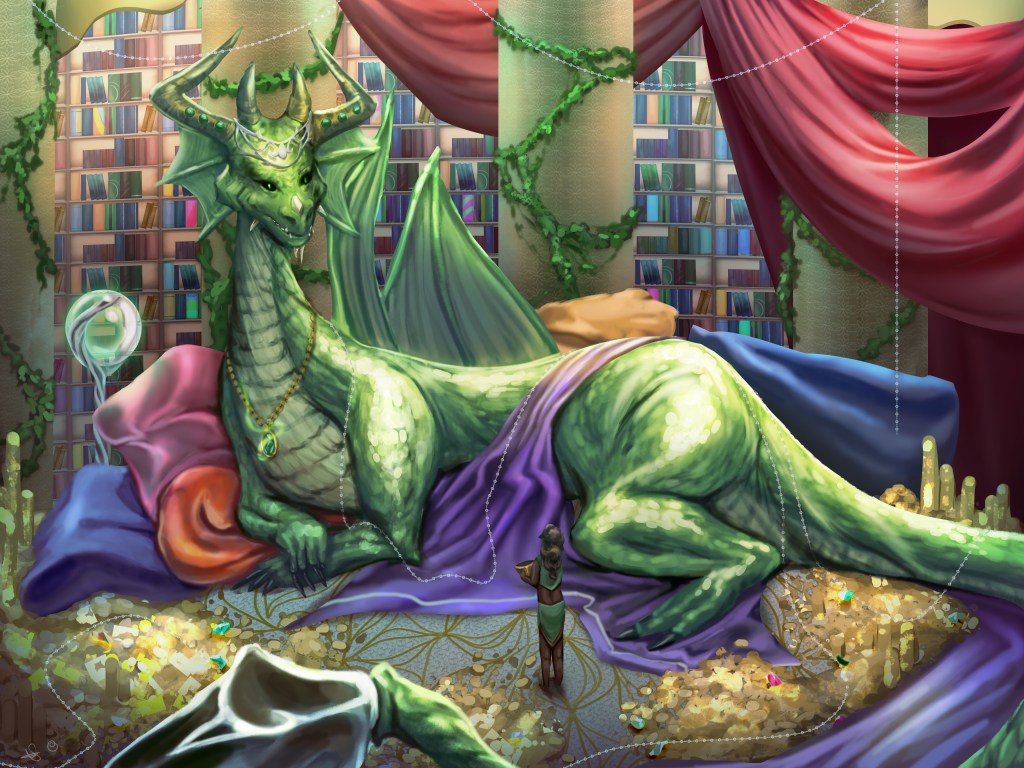
Now more than a thousand years old, the Dragon Queen Faeulas lies atop a hoard of treasures in the centre of Fiodrel wherein there is a city amongst the trees. Her people, drawn to her majesty and magic, guard her realm fiercely and adore her as a nigh on goddess. For the Queen is majestic. Her scales glitter as a coat of mail made of over lapping emeralds, except for beneath her neck and down to the tip of her tail where the greens become silver. Her teeth shine a brilliant white and her claws are of blackest obsidian. The length of her tail is enough to encircle the whole of her bedchamber and her wings cast a vast shadow on the world below when in flight. The tip of her tail tapers to a silvered spear-like point and her head is crowned with great horns of gold.
The great Queen does not lie upon her treasure naked. Her people have gathered for her much wealth and it adorns her massive form. Huge rings of gold set with many gems adorn her clawed fingers and great bolts of purple silks trimmed in silver threads draped her draconic form. Piercings of jade adorned her head and chains of crystal dangled from fin-like ears. About her long and powerful neck hung a single chain of adamantine links that were so fine as to appear as string. They held an amulet of emerald about her chest, rimmed in gold and aglow with her sorceries. Piles of books and scrolls, manuscripts from every era and place, piled high about her and a grand scrying orb of crystal on a stand of shining brass stood near to her head.
And yet for all the grandeur the Dragon Queen Faeulas of Fiodrel mustered in her private abode, the two most wonderous gems were her eyes. Black they were, as dark as the night sky, and punctuated by slits of green that looked as towers of viridian fire. It is said that these flaming orbs are enough to capture the minds and spirits of lesser folk, enticing them to serve and love her as their true and rightful queen.
Not in malice does Faeulas horde splendours. Her cunning and her magic combined with her physical might guard the Northlands against the scorched Ashlands and keep the beasts of the Calamity from feasting upon the Ever-on Forest at the world’s heart. Perhaps most importantly, Faeulas stands against the second figure of this missive – the Wraith King of Urumar.
For to the south of Fiodrel lies the land of Fingale. And there the magics of Faeulas clash with the insidious powers of Urumar to its west. In stark contrast to the lush and verdant Fiodrel, Urumar lies bleak and desolate. Sparse grasses and shrubs grow along the rocky terrain and few trees take root there. A feeling of dread grips the minds of all who come to walk its crags and ridges, and spirits roam the land more commonly than birds.
To its north lie mountains that in one place split into a pass that leads into the Ever-on Forest and the Heart of the World. To the West of this pass the range reaches southward, culminating in the highest peak in Urumar. The mountain is called Ardoriad and built into its southern face is the bleak tower of the Wraith King; the fortress called Drador.
At the tip of this black-stone spire lies the Wraith-King’s abode. A dark and circular place with no visible means of entry nor of escape. At the centre was a cauldron of black iron stood on devilishly carved onyx feet. From it a sickly blue-green glow emanated, shrouded in a shadowy fog that shifted and swirled about the surface of a bubbling ichor contained within. Torches of black and white flame lined the walls, each set into the relief of grotesque black-iron faces adorned with demonic horns and sharpened pearls for teeth.
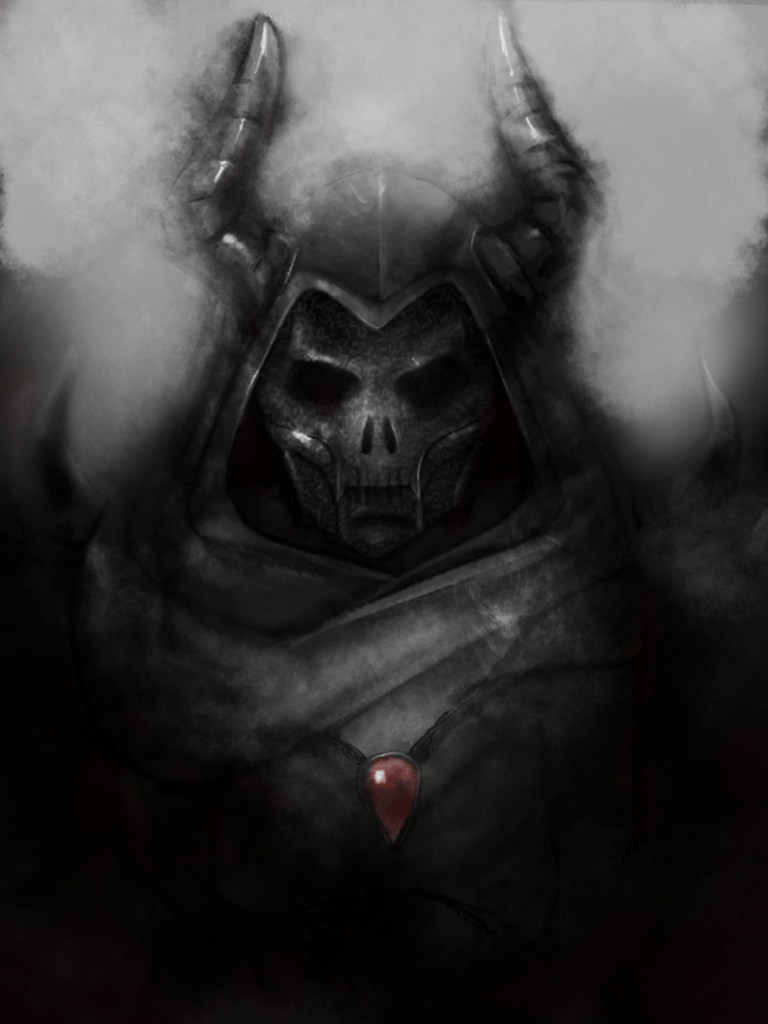
The Wraith King, nameless save for his title, appeared as a man though impossibly tall and wreathed in shadow that appeared to slither about his dark-robed form. A great hood covered his head, and a mask of some nameless cold black metal covered his featureless face. It was engraved with flowing symbols, scripts, and runes. Its eyeholes were empty and dark, seeming to absorb what meagre light lay in the room. A pair of tall horns of that same black metal protruded from it and above the rim of his hood lined in a strange red glow and they, too, were inscribed with powerful symbols.
Upon his chest sat an amulet that hung upon a black chain. It was of an evil red and seemed to be a gem filled with blood set into an obsidian relief of a demon’s mouth. His arms, shoulders, hands, and boots were clad in silvery black armour, ridged with flowing spikes and adorned with the same inscriptions as his mask. Upon his belt hung a sword whose pommel and guard seemed to be of black thorns and in his left hand he held a staff of black wood, topped with an orb the same sickly blue-green as the contents of his cauldron.
Where the Dragon Queen shone brightly, the Wraith King skulked in the dark of his fortress tower and wove evil enchantments and spells about the land of Urumar, reaching ever out toward Fingale and his adversary’s verdant lands beyond. For he too had appeared after the defeat of the undead monsters from the east, as if to serve as a dark and veiled personification of the memory of those horrors.
This piece was written some time ago and given very little editing since. Its purpose was to provide inspiration to the artist, @shanwichartist, so that she might better paint Faeulas the Dragon Queen and the Wraith King of Urumar.

 Lost Lore Library