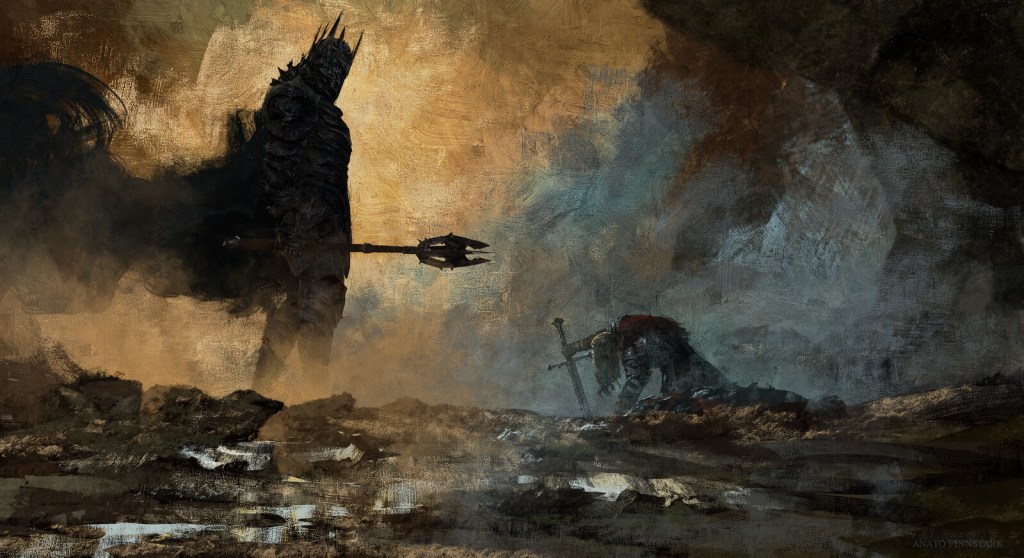
Some time ago I found myself as I often do; engaged in a lively discussion on the nature of Tolkien’s orcs. To boil it down; were the orcs pure evil and irredeemable or were they good creatures marred beyond recognition yet still capable of redemption?
Without getting into the thick weeds of Tolkien’s own particular thoughts on the matter I took a holistic view; that the orcs were written to be evil and that is that. Should Eru wish to redeem the orcs then He certainly could, yet we do not know of that. We simply know that the orcs were evil and served evil. They were the vast bulk of Morgoth’s and Sauron’s forces, serving as cannon fodder for the mythical heroes of his Legendarium to slice through.
Since the nature of Tolkien’s orcs is not the main topic of this missive I shall simply leave an interesting video to consider here and move on.
The conversation led me to ponder our modern attitudes to ‘evil’ in Fantasy. The traditional view of evil in the genre is that there are good races, races that comprise both good and evil individuals, and evil races. For the sake of discussion we shall take three races from classical fantasy.
Elves tend to be a goodly race. They are rarely, if ever, viewed as a race that is evil. No doubt this is inspired by Tolkien’s view of them, even if a great many elves in his mythos were far from perfect.
Humans tend to be a mixed race. They are viewed as mostly good though easily corrupted to the side of evil. Again this is likely taken from the Menfolk of Tolkien’s world as he is the grandfather of all Fantasy. It is fair to say that it is reflective of humanity in the real world. We strive to be good and yet so many of us fall so short.
Orcs tend to be an evil race and in most Fantasy settings are purely evil. Attempts have been made in the modern age to provide them with what corporate types will call ‘nuance’, yet the bulk of fantasy thought views them as evil monsters. Rightly so, in my opinion, as the word orc simply means monster.
This traditional view of the Fantasy genre has provided a sort of modern mythos for us. We recognise that there is individuality within racial groups and at the same time we are provided with a framework for navigating the various worlds we are presented with. In my view this is highly advantageous for being able to hop from one mythology to another. I see few down sides to the heroes of a given story in any given world viewing certain racial groups in well defined moral lights.
Yet the more ‘corporate’ stream of thought disagrees. The last book I purchased from Wizards of the Coast was Fizban’s Treasury of Dragons in October of 2021. This book was one of the first examples of the abandonment of traditional alignments in Dungeons and Dragons. Rather than races being aligned as good or evil based on their race, the language became ‘typically evil’ or ‘typically good’. I am told newer releases have continued this trend.
It is quite obvious to myself that this is politically motivated and an attempt to move away from the language of race. I believe the more sci-fi term of ‘species’ is now substituted. This is understandable, I suppose. No corporation wants to be slapped with the ‘racist’ label. Yet it does open up a larger dialogue on the genre as a whole; and one that I think a certain Drow Ranger from Menzoberranzan is most familiar with.
The Legend of Drizzt by R.A Salvatore is one of my favourite series of books. Drizzt himself is an insightful thinker and, between parts, will often speak to the reader directly in the style of journal entries, signing off with the ever comforting ‘Drizzt Do’Urden’.
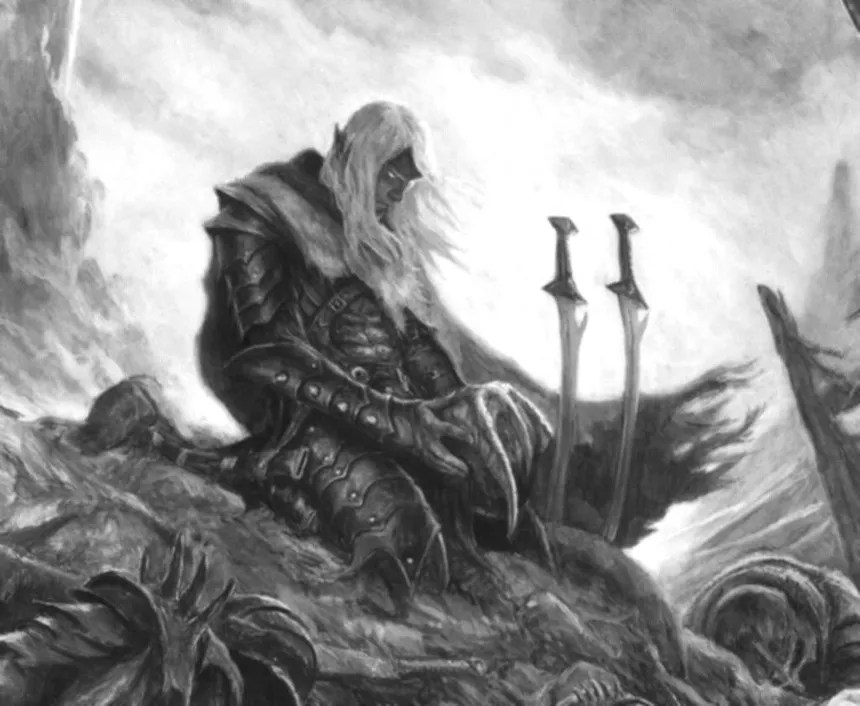
Without wishing to spoil certain events of later novels, I shall provide here a brief overview of an event or two in Drizzt’s storied career that caused the thoughtful Drow to wonder about the nature of good, evil, and race within his setting.
The Drow, or Dark Elves, are (or were, thank you WotC) an evil race of subterranean elves. Drizzt Do’Urden and his mentor Zaknafein were two shining examples of Drow that were born struggling with the evil society they found themselves in. For they were good at heart yet forced to persist in a society that demanded evil of them. For all of Drizzt’s time in the great Dark Elf city he only knew of two Drow that were good. Himself and his mentor – and even then he did not know of Zaknafein’s same struggles until much later. So secretive they had to be – or risk being killed.
Upon his escape from the Underdark, Drizzt’s first few decades on the surface were spent battling the racial prejudice of the surface peoples against the Drow. Yet for all the pain this caused him, he accepted it. The Drow, his people, would sooner commit all manner of atrocities against the people of the surface than ever consider friendly relations. Many of his journal entries stem from this want to do good and yet struggling to reconcile it with his dark heritage.
He even notes that he knew of one goblin, one singular example of goblin kind, that was good. Just one of them that did not desire the death and destruction of the goodly folk of the world. The whole dynamic of Drizzt’s constant struggle to overcome the evil reputation of his people is a motivating and awe-inspiring tale of a truly exceptional individual sticking to his principles to the point of becoming a legendary hero.
This backdrop of racial tensions, of overcoming reputations of your kinfolk, and of rising to be one of the greatest characters in Fantasy fiction ever, is undone by the perceived need to move away from evil races.
For if there were many good Drow then the exceptionalism of Drizzt Do’Urden is sorely reduced. The reactions of the surface folk to a Dark Elf appearing at their gates would not be as hostile. It would not be driven by a fear of his dark skin and pointed ears. It would simply be the same suspicion that all strangers might receive.
It is a great irony that, in an attempt to do away with racial stereotypes and promote individualism, the ‘corporate’ stream of thought has instead homogenised the genre and the possible stories one might tell within it. They have removed from the genre the character of its modern mythology in favour of bland corporate language.
A greater irony is that it is in aide of the pursuit of profit. Greed, a vice and something quite evil, drives the empty suits of companies like Wizards of the Coast to try and appear good. Not for the sake of goodness do they appear to do good, but for the sake of their bottom line.
I suppose I have rambled on quite enough for today. Suffice it to say that, in your writing or on your table top, be not afraid to have all of your dragons be evil. And be not afraid to have one singular example of an evil creature striving to be good.
It is only fiction, after all.

 Lost Lore Library
One response to “Musings: The Necessity of Evil Races in Fantasy and the Experiences of Drizzt Do’Urden”
[…] through the Twitter I discovered a blog post that really resonated with me. It was titled “Musings: The Necessity of Evil Races in Fantasy and the Experiences of Drizzt Do’Urden,” and I hope the author would find it fair if I summarized the general argument of his post […]
LikeLike